CORA — Compliance & Regulatory Assistant
CORA is a regulatory intelligence workspace for homologation, compliance, and engineering teams who cannot afford ambiguity. It turns authoritative regulations and standards into clear outputs that remain traceable, version-locked, and defensible—grounded in original source text.
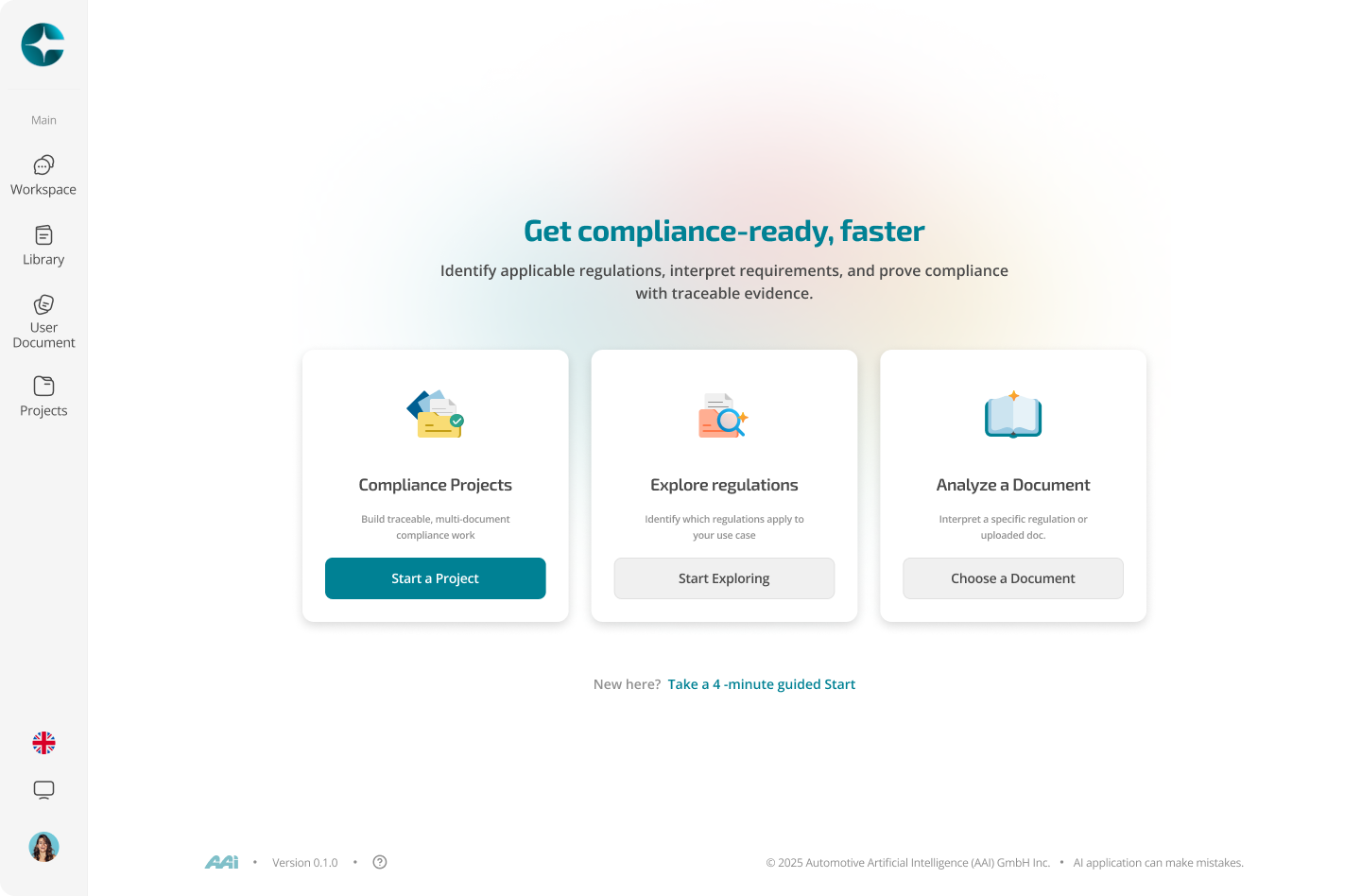
What CORA is designed for
Regulatory work fails in predictable ways: the right sources are hard to find, versions get mixed, and decisions become difficult to defend later. CORA is designed for workflows where accuracy, traceability, and version discipline are non-negotiable.
Use CORA to:
- Identify which regulations and standards apply to a use case, system, or program scope
- Interpret requirements against an explicit document version
- Traverse cross-references across sources without losing context
- Work across multiple linked documents inside a defined project boundary
- Produce notes and requirements that stay linked to the clauses that justify them
CORA is not a general-purpose chatbot. It is built to produce outputs you can inspect, cite, and defend.
How CORA works
CORA is structured around three working modes. Each mode is a deliberate constraint to keep outputs reliable.
Explore — Discover what applies
Use Explore when you are orienting and scoping: What applies, and where should I start?
Explore helps you discover relevant regulations and standards, follow references, and build an initial map of the landscape.
Typical questions:
- “Which regulations apply to this feature, system, or vehicle type?”
- “What standards are typically required alongside these regulations?”
- “What is the regulatory scope for this use case in the EU context?”
What you should get:
- A curated list of applicable regulations and standards
- High-level relevance explanations tied to the use case
- Clear entry points into the correct documents for deeper analysis
Interpret — Get version-locked answers
Use Interpret when you need precision from a single source: What does this clause require in this exact version?
Interpret runs in a document-locked context (Library document version or User Document). Answers remain grounded in that version with direct clause-level references.
Typical questions:
- “Summarize Article X as actionable obligations.”
- “Is this wording mandatory, conditional, or informative?”
- “What are the exceptions and boundary conditions in this annex?”
What you should get:
- Answers grounded to the selected version and location within the document
- Citations that point to the exact clauses/articles/annex items used
- No cross-document assumptions or external inference
Project Context — Work across multiple documents
Use Project Context when you are executing structured work across a defined scope: How do these sources interact for my project?
You create a project, link documents (Library + User Documents), and work within a shared multi-document context. Project instructions guide all threads, and outputs remain traceable to the source content used.
Typical questions:
- “Map UNECE requirements to ISO obligations for this feature.”
- “Show overlaps, conflicts, and dependencies across linked sources.”
- “Map requirements from one document to obligations in another.”
What you should get:
- Cross-document answers with evidence from each source
- Structured outputs you can reuse (requirements, notes, trace packs)
- Repeatable, auditable reasoning within the project boundary
Core building blocks
CORA is built on four foundational elements:
-
Library
Canonical regulations and standards with structure, versions, languages, and relationships. -
User Documents
Uploaded documents that can be viewed, cited, and interpreted alongside library sources (clearly labeled as user-provided). -
Threads
Conversations operating in Explore, Interpret, or Project Context mode—each with explicit scope rules. -
Projects
Structured workspaces that link documents, preserve scope, and store outputs such as notes, requirements, and trace history.
Why teams use CORA
- Traceability by design — citations, grounding sources, and navigation history are preserved
- Version awareness — answers are tied to explicit document versions for audit-safe reasoning
- Structured outputs — requirements and notes stay linked back to evidence
- Reduced ambiguity — users can inspect exactly where conclusions come from
- Lower certification risk — fewer scope misses, fewer version mistakes, stronger defensibility
Get started
- Access & Login
- Workspace Tour
- Your First Answer (Explore)
- Modes & Threads
- Projects
- Citations & Traceability
Important note
CORA provides structured regulatory guidance and source-backed interpretation. It does not replace legal counsel, regulatory authorities, or formal certification processes. Always validate outputs by reviewing cited source text.